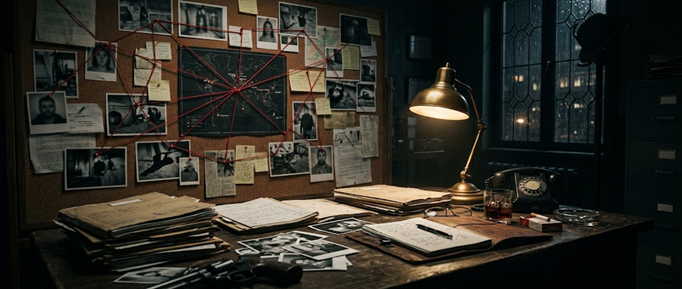
The cases that won't stay buried.
Crime Docket
Independent Investigative Journalism | Est. 2026

We examine the public record — court filings, police reports, forensic evidence, and verified witness accounts — to bring clarity to cases that have gone unanswered for too long.
View Investigations

Featured Investigations
Cold Case
The Killing of Tupac Shakur
Two decades of sealed records, shifting witness statements, and a confession that came too late. A full timeline reconstruction from court documents and original source material.
By Maria Santos · Jan 15, 2026
Unsolved
The Dayton Strangler
At least five women found strangled in abandoned buildings across Dayton, Ohio since late 2023. Police suspect a serial killer, but no suspect has been identified.
By Maria Santos · Feb 3, 2026
Criminal Justice
27 Years on Death Row
Elwood Jones spent 27 years on Ohio's death row for a murder he did not commit. His case was formally dismissed in December 2025. A Crime Docket investigation into what went wrong.
By David Kim · Dec 20, 2025

Cold Cases
Unsolved Homicides
Criminal Justice
Document Analysis
Case Timelines

By the Numbers
3
Active Investigations
120+
Documents Reviewed
5,000+
Hours of Research

Every document tells a story. Most people never read them. We do.
— Crime Docket Editorial Team.

Stay on the Case
New investigations and case developments delivered to your inbox. No spam. No speculation. Just the facts.
LATEST NEWS
Latest News
Breaking developments in cold cases, active trials, and criminal justice — updated as stories develop.

Cold Case
DNA Breakthrough in 35-Year Charlotte Murder
Marion Gales was arrested after forensic DNA analysis linked him to the 1990 murder of a Charlotte victim. The case had gone cold for three and a half decades before investigators submitted evidence to a genealogy lab.
By Maria Santos · Feb 24, 2026 · 4 min read
Cold Case
Sarasota Sheriff Solves 1999 Murder
Kevin Holloway was arrested 26 years after the killing, following a renewed investigation by the Sarasota County Sheriff's Office. Authorities credited advances in forensic technology with cracking the case.
By Maria Santos · Feb 21, 2026 · 4 min read
Cold Case
Charges Filed in 1996 Morgan Violi Abduction
Robert Froberg has been charged in connection with the abduction of Morgan Violi in Kentucky — a case that remained unsolved for nearly 30 years. Prosecutors say new forensic evidence drove the charges.
By David Kim · Feb 18, 2026 · 4 min read
Cold Case
Arkansas Jane Doe Identified After 30 Years
Jamie Ann Moore of Conway, Arkansas has been identified as a Jane Doe whose remains were discovered in 1995. The identification was made through forensic genealogy and DNA comparison.
By David Kim · Feb 14, 2026 · 4 min read

All reporting verified against primary source documents.
Investigations
Trials & Breaking News
LIVE COVERAGE
Active courtroom proceedings and breaking developments — monitored and updated in real time by Crime Docket staff.

ACTIVE TRIAL
Kouri Richins Murder Trial Underway: Housekeeper Testifies She Supplied Fentanyl
A Utah mother stands accused of poisoning her husband Eric Richins with a fatal dose of fentanyl. During trial testimony, the family housekeeper stated she obtained fentanyl for Richins on four separate occasions. The case drew national attention after Richins published a children's grief book following her husband's death.
By Jack Rancher · Feb 27, 2026 · 6 min read
BREAKING NEWS
Federal Prosecutors Will Not Appeal Death Penalty Dismissal in Luigi Mangione Case
The Department of Justice has declined to challenge a court ruling that dismissed capital charges against Luigi Mangione, the suspect accused of fatally shooting UnitedHealthcare CEO Brian Thompson. A state trial is scheduled for June 2026, with a separate federal trial set for October 2026.
By David Kim · Feb 25, 2026 · 6 min read
COLD CASE
LA DA Charges Suspect in 1996 Murder After DNA Breakthrough
A 63-year-old man has been charged in the killing of Claudia Guevara, a cold case dating back to 1996. Los Angeles District Attorney prosecutors say forensic DNA evidence collected and analyzed in recent years directly linked the suspect to the crime scene nearly three decades after the murder.
By Maria Santos · Feb 22, 2026 · 6 min read

Crime Docket does not publish unverified claims. All trial coverage is sourced from court records and verified reporting.
ABOUT
About Crime Docket
Crime Docket is an independent digital news outlet dedicated to investigative reporting on true crime, cold cases, and criminal justice issues across the United States. Founded in 2026, Crime Docket was built to occupy a space that has long gone unfilled — the territory between entertainment and rigorous journalism.
While podcasts and YouTube channels have brought unprecedented attention to unsolved cases, the majority of that coverage relies on secondhand summaries, recycled narratives, and unverified speculation. Crime Docket takes a fundamentally different approach: every story begins with documents, not conjecture.

Primary sources. Always.
Our Method
Our investigative process begins with primary source documents — court filings, police reports, autopsy records, and verified witness accounts. We cross-reference these materials against existing reporting to identify gaps, contradictions, and overlooked evidence that may reframe a case entirely.
Our Team
Our Team
Led by Editor-in-Chief Jack Rancher, our team includes Senior Investigator Maria Santos, Legal Analyst David Kim, and Research Director Sarah Whitfield. Together, they bring decades of experience in investigative journalism, criminal law, and public records analysis.

Editorial Standards
We do not publish unverified claims as fact. Every assertion in our reporting is tied to a document, on-record source, or verified public record.
We clearly distinguish between established facts and editorial analysis, labeling interpretation as such in every investigation.
We cite our sources and provide document references — including redacted source documents — wherever legally and ethically permissible.
We respect the privacy and dignity of victims, their families, and witnesses, and adhere to all applicable laws governing records publication.

Select Crime Docket investigations are produced as long-form video documentaries on our companion channel, Silent Evidence. These productions are grounded in the same primary-source methodology as our written reporting.

VIDEO
Watch Our Documentaries
Select Crime Docket investigations are produced as long-form video documentaries on our companion channel, Silent Evidence. Each documentary is built on the same primary-source methodology as our written reporting — court documents, verified records, and original source material — presented in cinematic long form.
Silent Evidence publishes multi-part documentary series on cases where the visual and archival record is rich enough to support extended investigation. No dramatizations. No reenactments. Just evidence, context, and the story the documents tell.
What to Expect
  • Feature-length investigations
  • Primary source document walkthroughs
  • Timeline reconstructions
  • Expert legal and forensic context
Find Us On YouTube
Search for Silent Evidence on YouTube, or follow the link below to access our full documentary library.
OUR TEAM
Meet the Investigators
The journalists, analysts, and researchers behind Crime Docket's reporting. Every byline represents years of experience in investigative journalism, criminal law, and public records analysis.

Jack Rancher
EDITOR-IN-CHIEF
Jack Rancher has spent 15 years investigating cold cases and wrongful convictions across the United States. A former staff writer at the Chicago Tribune, he founded Crime Docket in 2026 to bring primary-source rigor to true crime journalism. His work has been cited in federal court proceedings.
Daniel Zowada is an experienced investigative reporter with a focus on violent crime and criminal justice reform. He specializes in cold case reconstruction and primary source document analysis for Crime Docket's ongoing investigations.
Chad Gembel brings a background in legal research and FOIA compliance to Crime Docket. He manages the document acquisition pipeline and handles public records requests, ensuring every investigation is built on verified source material.
Rozanne Zowada contributes digital forensics and open-source intelligence expertise to Crime Docket's investigative process. She specializes in geolocation analysis, metadata extraction, and timeline reconstruction from digital evidence.

Work With Us
Crime Docket accepts pitches from experienced investigative journalists and researchers. We are particularly interested in cold cases with documented primary source material.
We don't cover crime for entertainment. We cover it because the record demands accountability.
— Crime Docket Editorial Charter
INVESTIGATIONS
Case Timelines
A chronological reconstruction of key events in each active Crime Docket investigation — built from court documents, police reports, and verified public records.

COLD CASE
The Killing of Tupac Shakur
Sept. 7, 1996 — Present · Lead Investigator: Jack Rancher

1
Shooting at Flamingo Road
Tupac Shakur is shot four times in a drive-by following the Bruce Seldon–Mike Tyson fight at the MGM Grand in Las Vegas. He is rushed to University Medical Center.
2
Tupac Shakur Dies
Shakur dies six days after the shooting at age 25. No arrests are made. The LVMPD investigation stalls within months. The case goes cold.
3
Witness Statements Shift
Over a decade, key witnesses recant or contradict earlier accounts. Several figures connected to the case die under disputed circumstances. Sealed records remain inaccessible.
4
Keefe D Arrested
Duane "Keefe D" Davis is arrested and charged with murder in connection with the shooting — the first arrest in the 27-year-old case. He had previously claimed involvement in a 2011 memoir.
5
Trial Proceedings Begin
Keefe D's trial begins in Las Vegas. Crime Docket is reviewing all available court filings, LVMPD reports, and trial transcripts as proceedings unfold.
ACTIVE COVERAGE

UNSOLVED
The Dayton Strangler
Late 2023 — Present · Senior Investigator: Maria Santos

1
First Victim Discovered
The body of a woman is found strangled in an abandoned building in Dayton, Ohio. Dayton PD opens a homicide investigation. No suspect is identified.
2
Pattern Identified — Four More Victims
Four additional women are found strangled in similar circumstances across Dayton. Medical examiner records confirm consistent cause of death. Detectives begin treating the cases as potentially linked.
3
FBI Joins Investigation
The FBI's Violent Crime Task Force joins the Dayton PD investigation. Geographic profiling and behavioral analysis are introduced. No public suspect has been named.
4
Crime Docket Investigation Underway
Crime Docket is reviewing police reports, medical examiner records, and geographic data. This investigation is ongoing. If you have information, contact tips@crimedocket.com.
ACTIVE — NO ARREST

WRONGFUL CONVICTION — CASE CLOSED
27 Years on Death Row: The Elwood Jones Case
1998–2025 · Legal Analyst: David Kim

1
Conviction & Death Sentence
Elwood Jones is convicted of aggravated murder in Hamilton County, Ohio and sentenced to death. He maintains his innocence from the outset. His appeals are denied repeatedly over the following decade.
2
Appeals Denied, Evidence Suppressed
Multiple appeals are filed and denied. Defense attorneys allege prosecutorial misconduct and suppression of exculpatory evidence. The Ohio Supreme Court declines to hear the case twice.
3
DNA Evidence Reexamined
New forensic DNA testing is conducted on physical evidence from the original crime scene. Results are inconsistent with the prosecution's theory of the case. A motion for new trial is filed.
4
Federal Review & Evidentiary Hearings
A federal court orders evidentiary hearings. Witnesses recant. A key prosecution witness admits to providing false testimony. The case draws national attention from wrongful conviction advocacy groups.
5
Case Dismissed — Jones Freed
Hamilton County prosecutors formally dismiss all charges against Elwood Jones. He is released after 27 years on death row. Crime Docket's full investigation into the systemic failures is forthcoming.
CASE CLOSED — EXONERATED

All timeline entries are sourced from court documents, verified news reports, and public records. Crime Docket does not publish unverified claims.
WEEKLY DISPATCH
Tip of the Week
Each week, Crime Docket's editorial team surfaces one investigative technique, legal tool, or research method drawn from active casework. These are the methods that move cases forward.

THIS WEEK'S TIP — Feb 28, 2026
How to Read a Redacted FOIA Document
Redactions are not erasures — they are maps. Every black bar in a FOIA-released document tells you something: the shape of the redaction, its position on the page, and the exemption code cited in the margin all point toward what the government is protecting. In our review of the LVMPD files related to the Tupac Shakur case, three recurring redaction patterns led us to a set of witness interview summaries that had never been publicly acknowledged. The technique is methodical, not speculative.
Start with the exemption codes. (b)(7)(C) protects law enforcement personnel. (b)(7)(D) protects confidential sources. (b)(6) protects personal privacy. When you see these codes clustered around a specific section, you know exactly what category of information is being withheld — and that tells you where to look next.
KEY TAKEAWAY
A redaction is not a dead end. It is a signpost. Learn to read what surrounds the black bars, and the document will tell you what it's hiding.
— Jack Rancher, Editor-in-Chief
This Week's Research Tools
  • MuckRock — FOIA request filing and tracking
  • PACER — Federal court document access
  • Othram — Forensic DNA genealogy
  • CourtListener — Free federal case law database
  • DocumentCloud — Annotated document publishing

Submit a Tip
Have information about an unsolved case? Our tip line is encrypted and confidential. We review every submission.

Previous Tips
How to Cross-Reference Police Reports Against 911 Dispatch Logs
Dispatch logs are often overlooked — but they timestamp every officer movement and can contradict official reports.
Using Genealogy Databases to Identify Jane and John Does
GEDmatch and FamilyTreeDNA have become essential tools for cold case investigators working unidentified remains.
Reading Autopsy Reports: What the Medical Examiner's Language Actually Means
Terms like 'consistent with' and 'cannot be excluded' carry specific legal weight. Understanding them changes how you read a case.
How to File a State-Level Public Records Request
Each state has its own sunshine law. Knowing the specific exemptions in your state determines what you can and cannot obtain.

The Tip of the Week archive is available to all Crime Docket subscribers. New tips published every Friday.
DOCUMENT ARCHIVE
Source Documents
Crime Docket publishes primary source materials wherever legally and ethically permissible. Below is a selection of redacted court filings, FOIA releases, and evidentiary records underlying our active investigations.

All documents published by Crime Docket have been reviewed by legal counsel. Personally identifying information for protected individuals has been redacted in accordance with applicable law.

LVMPD — TUPAC CASE
Las Vegas Metro PD Incident Report — Sept. 7, 1996
Original incident report filed by LVMPD officers responding to the Flamingo Road shooting. Key witness identification sections are redacted under (b)(7)(C). Obtained via Nevada Public Records Act request.
Filed: Sept. 8, 1996 · Released: Aug. 2023 · 14 pages · Partial redaction
COURT FILING — TUPAC CASE
State of Nevada v. Davis — Charging Document
The formal charging document filed by Clark County prosecutors against Duane 'Keefe D' Davis in September 2023. Includes the prosecution's theory of the case and cited witness statements.
Filed: Sept. 29, 2023 · Clark County District Court · 22 pages · Public record
FORENSIC REPORT — ELWOOD JONES
Ohio BCI DNA Reanalysis Report — 2020
Bureau of Criminal Investigation reanalysis of physical evidence from the 1998 Hamilton County crime scene. Results cited in the 2023 federal habeas corpus petition. Key findings contradict original prosecution forensic testimony.
Issued: March 2020 · Ohio BCI Lab · 31 pages · Obtained via FOIA
TRIAL TRANSCRIPT — ELWOOD JONES
State v. Jones — Trial Transcript Excerpt, Day 4
Transcript of prosecution witness testimony on Day 4 of the 1998 trial. Cross-referenced against the witness's 2024 recantation affidavit. Discrepancies identified on pages 112–118 are central to Crime Docket's investigation.
Dated: Oct. 14, 1998 · Hamilton County Court of Common Pleas · 47 pages
FOIA RELEASE — D.B. COOPER
FBI Dossier on D.B. Cooper — 398-Page Release, July 2025
The FBI's full 398-page investigative dossier on the 1971 D.B. Cooper hijacking, released in July 2025. Crime Docket has cross-referenced this document against FAA records and regional law enforcement files. Analysis ongoing.
Released: July 2025 · FBI FOIA Vault · 398 pages · Full release
MEDICAL EXAMINER — DAYTON
Montgomery County ME Summary Report — Victim 3, 2024
Redacted summary report from the Montgomery County Medical Examiner's Office relating to the third Dayton Strangler victim. Cause of death and manner of death confirmed. Identifying information withheld per Ohio Revised Code 313.10.
Issued: 2024 · Montgomery County ME · 8 pages · Partial redaction

Request a Document
Crime Docket maintains a full document archive for all published investigations. Verified journalists and researchers may request access to unredacted materials where permissible.
Submit a Document
If you have court filings, police reports, or other primary source materials related to an active investigation, our secure submission portal accepts encrypted uploads.

Crime Docket's document archive is maintained in accordance with SPJ ethics guidelines and applicable federal and state records law.
Investigations
Active Case Files
Every investigation published by Crime Docket meets a rigorous editorial threshold. Below are our current active cases and recently closed investigations — each built on primary source documents.

Cold Case
The Killing of Tupac Shakur: What the Records Show
By Jack Rancher, Lead Investigator · Published Jan 10, 2026 · Updated Feb 20, 2026 · 12 min read
On September 7, 1996, Tupac Shakur was shot four times in Las Vegas following the Bruce Seldon–Mike Tyson fight at the MGM Grand. He died six days later. No one has ever been charged. Over the subsequent two decades, witness statements shifted, key figures died under disputed circumstances, and confessions emerged — only to be recanted or disavowed. Crime Docket's reconstruction draws on court documents, LVMPD reports, and a methodical review of the timeline to examine what the official record actually shows.
UNSOLVED — ACTIVE INVESTIGATION
The Dayton Strangler: Five Women, No Answers
By Maria Santos, Senior Investigator · Ongoing · Last Updated Feb 26, 2026 · 8 min read
Since late 2023, at least five women from vulnerable populations have been found strangled in abandoned buildings and alleys across Dayton, Ohio. Detectives suspect a serial killer may be responsible, but no clear suspect has emerged. Crime Docket is reviewing police reports, medical examiner records, and geographic patterns to reconstruct the timeline.
WRONGFUL CONVICTION — CASE CLOSED
27 Years on Death Row: The Elwood Jones Case
By David Kim, Legal Analyst · Published Dec 15, 2025 · Case Closed · 15 min read
Elwood Jones was convicted and sentenced to death in Ohio in 1998. For 27 years, he maintained his innocence. In December 2025, his case was formally dismissed after new evidence revealed critical failures in the original investigation. Crime Docket examines the trial transcripts and forensic record.

Have information about an active case? Contact our tip line at tips@crimedocket.com
The Docket Blog
Longform analysis, editorial commentary, and dispatches from the field.
"The truth is like a lion; you don't have to defend it. Let it loose; it will defend itself."
— Augustine of Hippo
Latest Posts

The D.B. Cooper Files: What the FBI's 398-Page Dossier Actually Reveals
By Jack Rancher | February 20, 2026
~18 min read
In July 2025, the FBI quietly released a 398-page dossier on D.B. Cooper, the unidentified man who hijacked a Northwest Orient Airlines flight in 1971, collected $200,000 in ransom, and parachuted into the night over the Pacific Northwest. He was never found. The dossier includes deeper suspect profiles and investigative notes that had been sealed for decades. Crime Docket obtained the full document and spent four months cross-referencing its contents with FAA records, regional law enforcement files, and interviews with retired agents. What we found challenges several long-held assumptions about the case, including the widely accepted flight path and the timeline of Cooper's jump. This is the first in a three-part series reconstructing the evidence from the ground up.

DNA, Genealogy, and the New Cold Case Machine
By Jack Rancher | February 10, 2026
~14 min read
Forensic genealogy has quietly become the most powerful tool in American cold case investigation. Companies like Othram are using advanced DNA extraction and genome sequencing to solve murders that have been cold for decades. In 2025 alone, breakthroughs in California, South Carolina, and Ohio brought closure to families who had waited 20, 30, even 40 years. But the technology raises difficult questions about genetic privacy, the limits of consent, and what happens when law enforcement gains access to the DNA of millions who never opted in. This piece examines the cases, the science, and

CRIME DOCKET
Independent Investigative Journalism
Est. 2026 | United States
Crime Docket is an independent digital news outlet dedicated to rigorous investigative reporting on true crime, cold cases, and criminal justice.
Coverage
  • Cold Cases
  • Unsolved Homicides
  • Active Trials
  • Criminal Justice
  • Document Analysis
  • Case Timelines
Legal
  • Privacy Policy
  • Ethics Policy
  • Terms of Use
  • Contact Us
  • Tip Line
Email: tips@crimedocket.com

© 2025 Crime Docket. All rights reserved. Crime Docket is an independent publication. All reporting is based on public records and verified sources.